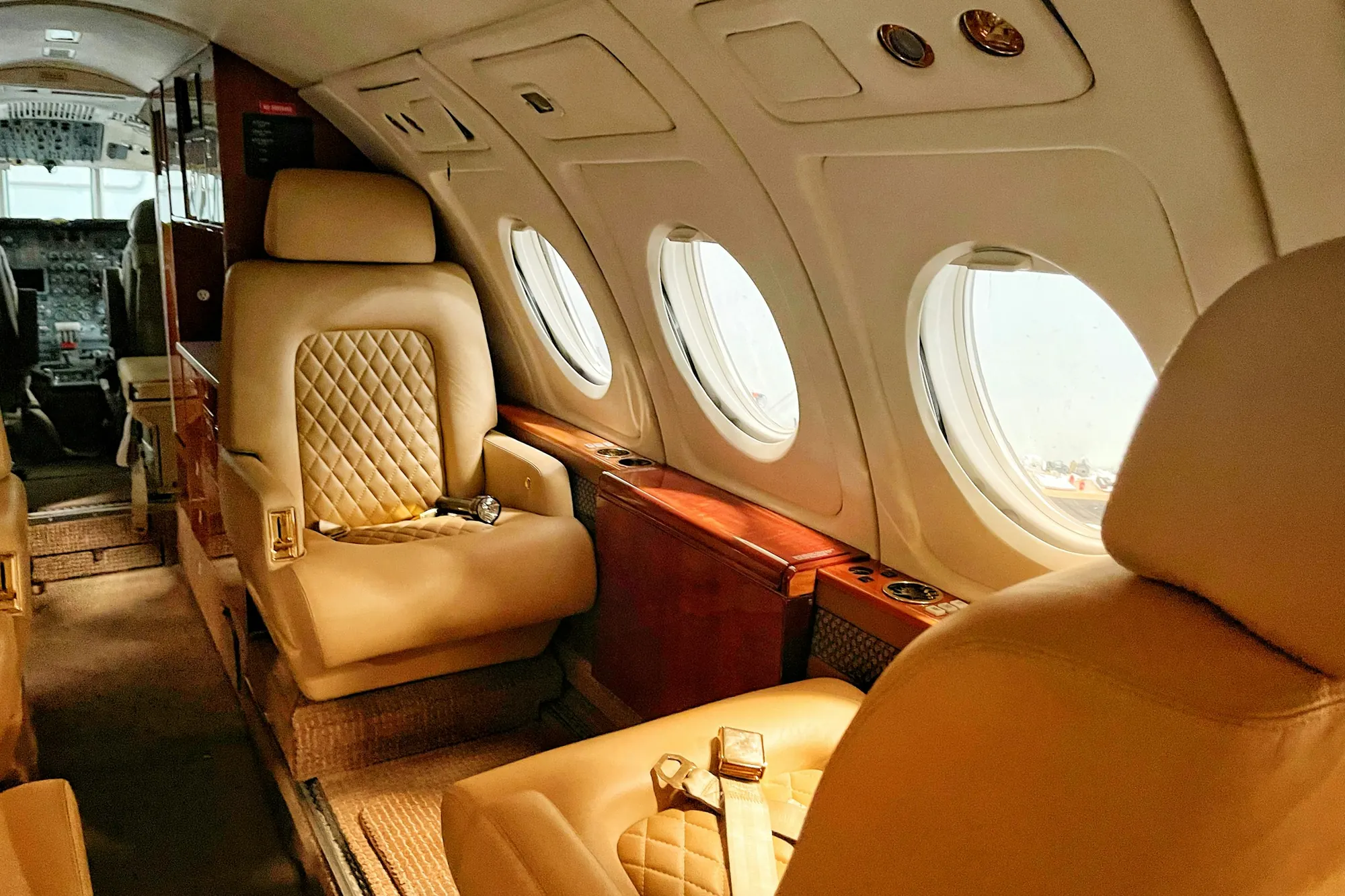
Two thousand dollars a seat is a number we hear often. It is roughly what a flexible premium airline ticket can cost on a busy domestic route, and it is the point where many travellers start to wonder whether a private aircraft is within reach. The honest answer depends on one thing more than any other: how many of the seats you fill.
Private charter is priced by the aircraft, not by the seat. A light jet costs the operator the same to fly with one passenger or seven. So a per-seat budget is really a total budget in disguise, and the useful question becomes what that total buys.
Start with the total, not the seat
Multiply $2,000 by the number of people travelling and you have the figure to work with. Four people give you $8,000. Six give you $12,000. Eight give you $16,000. From there, the arithmetic is simple: divide by the hourly rate of the aircraft, after the 7.5% federal excise tax that applies to domestic charter, and you get the flying time the budget covers.
The table below does that division with typical US hourly ranges. It shows flight time only, before repositioning, daily minimums and extras, which we come back to further down.
| Group | Total budget | Turboprop | Light jet | Midsize jet |
|---|---|---|---|---|
| 2 people | $4,000 | 1 h 10 – 2 h 05 | 40 min – 1 h 05 | 30 – 50 min |
| 4 people | $8,000 | 2 h 20 – 4 h 10 | 1 h 20 – 2 h 10 | 1 h 05 – 1 h 40 |
| 6 people | $12,000 | 3 h 30 – 6 h 10 | 2 h 00 – 3 h 10 | 1 h 35 – 2 h 30 |
| 8 people | $16,000 | 4 h 40 – 8 h 15 | 2 h 40 – 4 h 15 | 2 h 10 – 3 h 20 |
Two things jump out. First, the group size changes everything: the same $2,000 a seat buys four times as much aircraft time for eight people as it does for two. Second, the aircraft class matters almost as much. A turboprop at the low end of its range covers close to twice the time of a light jet, although it also needs more time for the same journey.
Four people: a short hop, done properly
With $8,000, a light jet covers roughly an hour and twenty minutes to two hours and ten minutes of flying. That comfortably includes trips such as Los Angeles to Las Vegas, about 50 minutes, or Westchester to Nantucket, about 45. On routes that short, the flying itself is not the constraint. The daily minimum is: many operators bill at least one to two hours a day whatever the clock says, so a 45-minute hop can be charged as an hour or more.
For four people on a short route, a turboprop is often the better buy. A Pilatus PC-12 class aircraft seats six to nine, lands on shorter runways and typically costs $1,800 to $3,200 an hour. The flight takes a little longer, but at 45 minutes the difference is about ten minutes, not an hour.
Six people: the sweet spot
Six seats at $2,000 make $12,000, which is where private flying gets genuinely interesting. Take Teterboro to Palm Beach, about two and a half hours. In a light jet at typical rates, the flight time comes to roughly $9,400 to $14,800 including the excise tax. Shared six ways, that is about $1,570 to $2,460 a seat. At the lower half of the range, with an aircraft already near Teterboro, the trip fits the budget.
Six is also a natural load for a light jet. The Phenom 300E and Citation CJ4 class seat six to eight, so six people travel without squeezing, and soft bags fit in the hold.
Eight people: more seats, more options
At eight passengers the budget reaches $16,000, and a midsize jet becomes realistic for flights of two to three hours. The cabin is taller, about 5.7 feet against 4.8 to 4.9 in a light jet, and the hold takes golf bags and skis more easily. A light jet can still carry eight on some types, but it will be full, and luggage becomes the deciding factor.
Where $2,000 a seat stops working
The arithmetic is honest, which means it also shows the limits. A few situations push the real cost well past the table.
- Small groups. Two people with $4,000 can afford roughly one to two hours in a turboprop, and a daily minimum can swallow much of that.
- Long flights. New York to Aspen is about four and a half hours. In a midsize jet that is roughly $21,800 to $33,900 for the flight time, or about $3,100 to $4,800 a seat for seven.
- Repositioning. If the nearest suitable aircraft is an hour away, that hour is usually billed, and a one-way trip may include the flight home empty.
- Peak days. Holiday weekends and big events tighten supply. Prices rise and cheaper aircraft go first.
When $2,000 buys more: empty legs
An empty leg is a flight an aircraft has to make anyway, usually to reposition after dropping off another charter. Operators often sell these one-way legs at 25 to 75 percent below a standard charter price. For a group that can travel on the operator's schedule, an empty leg can turn a trip that costs $3,000 a seat into one that costs well under $2,000.
The catch is flexibility. The route and departure time are fixed, and the leg can be cancelled if the original trip changes, so it suits travellers with a backup plan. We check for empty legs on every request, and tell you when one is close to your dates.
What about a single seat?
If you are travelling alone or as a couple, the whole-aircraft arithmetic is harder to make work. On some routes, seats on shared flights are sold individually, and the price per seat can be much lower than chartering the aircraft. These flights run to fixed schedules on a limited number of routes, so they are not always an option. When one fits your dates, we say so alongside the charter options.
Five ways to make the number work
- Fill the seats. The cost per person falls with every passenger added.
- Choose the smallest aircraft that carries your group and bags comfortably.
- Be flexible by a day, which opens up empty legs and quieter days.
- Depart from an airport where a suitable aircraft is already based, to keep repositioning short.
- Consider a same-day or next-day return, so the aircraft is not flying empty for you.
If you have a budget in mind, put it in your request. A good charter advisor will tell you plainly what it buys, which options come close, and which do not. That is how we work: every option comes with one all-in price, including the excise tax and fees, so the comparison is easy. You can also run the numbers yourself in the budget planner.